Loro Piana vs Brunello Cucinelli: Which Italian Cashmere Brand Is Actually Better?
Loro Piana and Brunello Cucinelli are the two names that come up first when someone asks which Italian house makes the best cashmere, and they are often priced within a few hundred dollars of each other. They are not, however, the same kind of company. Loro Piana grew out of a textile mill and still presents itself through fibre and fabric. Brunello Cucinelli began in 1978 with dyed cashmere sweaters and has grown into a full wardrobe house built around a particular idea of understated, relaxed dressing.
This comparison covers history and ownership, how each house talks about its fibre, how the knitwear differs in weight and finish, what the sweaters cost at retail, and which buyer each brand tends to suit. Where a claim comes from the brands themselves rather than from independent testing, the text says so.
Quick Answer: Which Should You Choose?
Choose Loro Piana if the priority is a fine, light, very soft knit and a plain, minimal silhouette, and if you are comfortable paying for the house’s fibre-first reputation. Choose Brunello Cucinelli if you want knitwear that sits inside a wider wardrobe of trousers, jackets and shirts, with more texture, more colour range and a looser, lived-in feel. Both sit at the top of Italian knitwear, and neither is a safe pick for someone on a strict budget. For a lower-priced route to similar construction, see Loro Piana cashmere sweater alternatives.
Loro Piana vs Brunello Cucinelli at a Glance
| Category | Loro Piana | Brunello Cucinelli |
|---|---|---|
| Founded | 1924, Quarona (Piedmont), by Pietro Loro Piana | 1978, by Brunello Cucinelli; base in Solomeo, Umbria |
| Origin | Textile and yarn business | Dyed cashmere sweaters, later a full ready-to-wear house |
| Ownership | LVMH bought 80% in 2013; the Loro Piana family kept a minority stake | Listed company; founder reported to hold just over half of the shares as of mid-2025 |
| Signature fibres | Baby Cashmere, vicuña, Storm System and other technical wool fabrics | Cashmere across a wide range of weights, with ribs, textures and colour |
| Typical look | Clean, light, minimal | Relaxed, textured, often slightly fuller |
| Beyond knitwear | Outerwear, shoes, bags, home | Full men’s and women’s wardrobe, plus shoes, accessories and home |
| Sweater price at one US retailer (Nov 2026) | Roughly $1,600 to $2,400 for crew and turtleneck styles; $3,500 and up for jackets and cardigans | Roughly $1,000 for a half-zip, rising to $3,000 to $5,000 for embellished or heavier pieces |
Prices come from a single multi-brand retailer’s US listings in November 2026 and move by season, colour, fibre blend and market. Always check the product page for fibre content, since not every listed sweater from either house is pure cashmere.
Brand Heritage and Ownership
Loro Piana: From Mill to Luxury House
Loro Piana was founded in 1924 in Quarona, in the Valsesia area of Piedmont, by Pietro Loro Piana, and its roots lie in wool and yarn production rather than in fashion design. Manufacturing remains concentrated in Italy’s Valsesia area, and the company also operates a facility in Mongolia near Ulaanbaatar, where cashmere is processed close to the source. The house is headquartered in Milan.
In July 2013, LVMH acquired an 80% stake, with the Loro Piana family keeping the remaining 20%. Reports at the end of 2025 indicated that LVMH had raised its holding further, to roughly 94%. The house has also been associated with vicuña, one of the rarest and most expensive fibres used in clothing: it began working with vicuña in 1994 and signed a 1997 agreement with Peru limiting sourcing to fibre from live animals.
For the wider Italian context, including how the Biella and Valsesia textile districts shaped the industry, see the complete guide to Italian cashmere and how Italian cashmere is made.
Brunello Cucinelli: From Coloured Cashmere to Full Wardrobe
Brunello Cucinelli founded his company in 1978, and his first product was brightly coloured cashmere sweaters. That starting point explains why knitwear still carries so much weight in the house today. The company is centred on Solomeo, a medieval village in Umbria whose restoration the founder and his foundation funded, and the company describes its approach as “humanistic capitalism”, a philosophy that links commercial success to fair working conditions and the care of place.
The brand is publicly listed on the Milan stock exchange (since 2012), and the founder was reported to hold just over half of the shares as of mid-2025. The result is a house that has grown into a complete wardrobe label, where a cashmere crewneck is one element among tailoring, trousers, outerwear and shirts. Readers interested in how this fits the wider trend can see our look at Italian designer clothing.
Cashmere Quality: How to Judge It
Neither brand publishes the kind of independent test data that would let a buyer rank them by fibre alone, so it helps to know what is actually measurable when comparing cashmere.
- Fibre diameter: measured in microns. Finer fibre generally feels softer against the skin. Fine cashmere is commonly cited in the 14 to 16 micron range, with coarser fibre showing up in cheaper knits.
- Fibre length: longer fibres spin into stronger, smoother yarn that tends to pill less. Short fibres are one reason cheaper cashmere sheds and pills quickly.
- Yarn and gauge: a fine gauge gives a thin, drapey knit; a heavier gauge gives warmth and texture. A heavier sweater is not automatically better or worse than a lighter one.
- Finishing: washing, brushing and linking determine how the sweater feels on day one and how it ages.
What Loro Piana Says About Its Fibre
Loro Piana’s best-known cashmere claim is Baby Cashmere, which the house describes as coming from the fine undercoat of young Hircus goats raised in Inner Mongolia, with an average fibre diameter of around 13.5 microns. That is the brand’s own figure and description, not an independent measurement, but it is consistent with the house’s wider positioning around very fine fibre and a controlled supply chain from raw material to finished garment.
Because Loro Piana spins and finishes much of its own yarn, it can tune fibre selection and finishing to a house look: light, smooth, and soft rather than bulky. This is the main reason the house is the usual reference point for “softest cashmere” conversations, although softness is also a matter of taste, and some buyers prefer a firmer, denser hand.
What Brunello Cucinelli Offers
Cucinelli’s cashmere is also high-grade, but the house is less focused on a single flagship fibre claim. Its emphasis is on a broad range of knits: fine-gauge crewnecks, English-rib and chunkier textures, half-zips, cardigans and hooded styles, often in a wide palette of muted colours. The fibre itself is generally described in the context of the finished garment instead of a headline micron figure.
For a buyer, the practical difference is that Loro Piana pitches the fibre first and the garment second, while Cucinelli pitches the garment and the way it fits into a wardrobe. Both can be very good in the hand; the better test is to handle a sweater in each weight you would actually wear.
Design and Fit
| Style | Loro Piana | Brunello Cucinelli |
|---|---|---|
| Crewneck | Clean, fine-gauge, minimal neckline | Often slightly fuller, with more visible rib or texture |
| Turtleneck | Lighter, used as a base layer under jackets | Often thicker and more substantial as a standalone piece |
| Half-zip and zip-up | Present but not the focus | A wider selection, including cardigans and hooded zips |
| Colour | Neutral, restrained palette | Broader range of muted and earthy tones |
| Branding | No logo on most knitwear | Discreet; the house is known for quiet logoless styling |
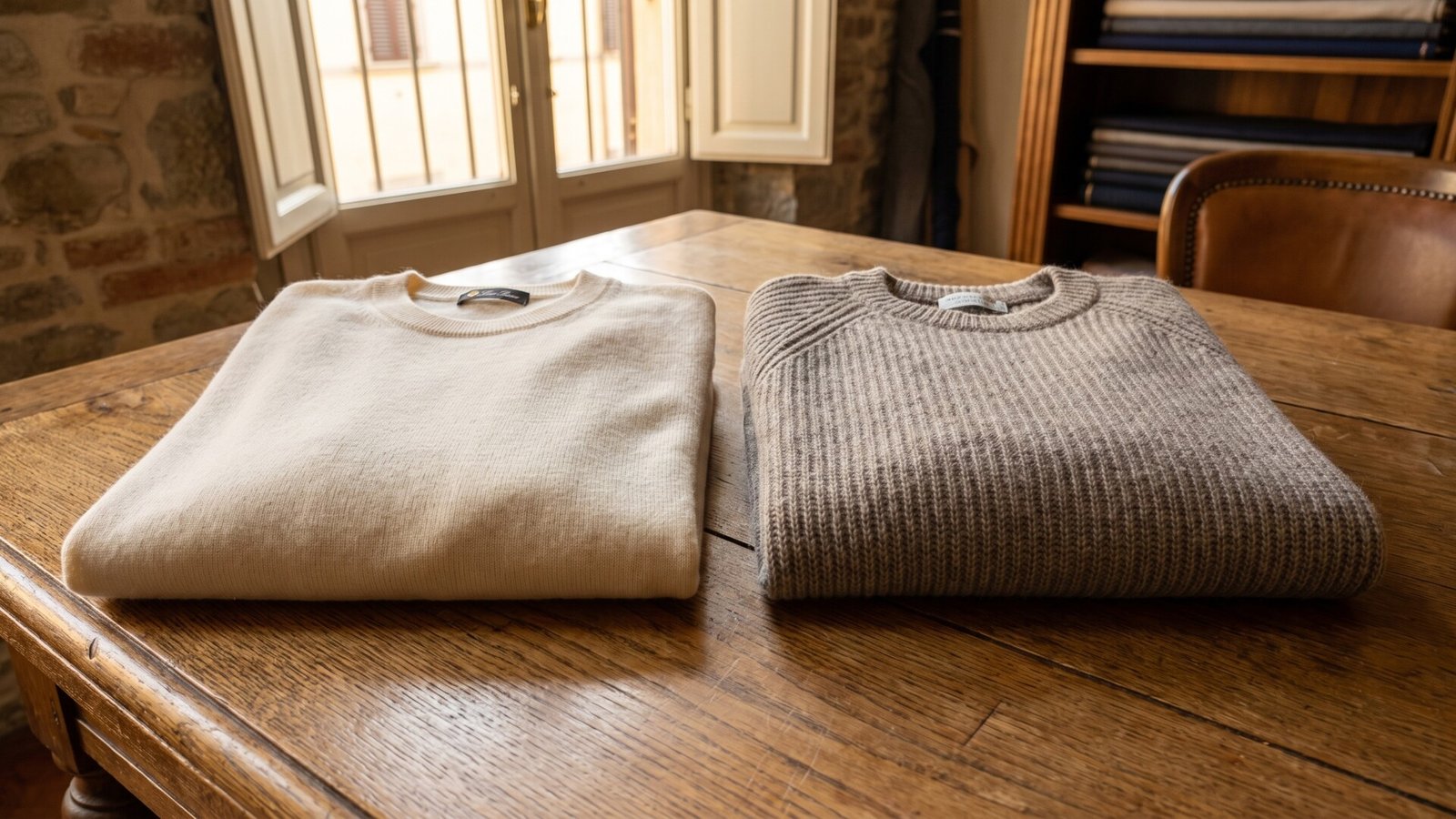
The broad pattern is that Loro Piana’s knits are designed to disappear into a minimal outfit, while Cucinelli’s are designed to be seen quietly, through a rib, a collar shape or a colour. Neither house is trend-led. Both belong to what the site covers under Italian cashmere and quiet luxury, where subtlety and fabric quality matter more than a visible logo.
Price: What You Actually Pay
At the time of writing, a US retailer’s listings showed Loro Piana crewneck and turtleneck sweaters at roughly $1,600 to $2,400, with jackets, bombers and heavier cardigans from about $3,500. The same retailer listed Brunello Cucinelli cashmere sweaters from just under $1,000 for a half-zip up to roughly $3,000 to $5,000 for embellished, zip-front or heavier pieces.
Three cautions apply. First, many sweaters from both houses use blends such as cashmere with silk or wool, or technical fabrics, so a lower price does not always mean a lower-quality cashmere. Second, retail prices differ by country, season and colour, and discounts at end of season can be substantial. Third, a simple cost-per-wear calculation can be misleading, because wear depends on how the sweater is cared for: a $1,800 sweater worn 40 times a year for eight years costs about $5.60 per wear, but only if it survives eight winters without moth damage or heavy pilling. For care guidance, see our notes on how cashmere is made, which explain why gauge and finishing affect how a knit ages.
Durability and Pilling
All cashmere pills to some degree, because the fibres are short and fine. Pilling is driven by fibre length, yarn twist, gauge, wear patterns (friction under bags and seat belts) and washing method, rather than brand name alone. Neither house guarantees a pill-free sweater, and no independent comparison between them appears to be published. A realistic expectation for either is that a well-made sweater, de-pilled gently with a cashmere comb and washed sparingly, can last many seasons.
Heavier, denser knits tend to hold their shape better, while very light, fine-gauge knits show wear faster at elbows and cuffs but feel more refined. That trade-off is more useful than a claim about which brand “lasts longer”.
Who Should Buy Loro Piana?
- Buyers who prioritise softness and lightness: especially for layering under tailoring.
- Minimalists: logo-free, neutral styling that suits a small, consistent wardrobe.
- Fibre-focused buyers: those who value the house’s textile heritage and fibre story, including Baby Cashmere.
- Gift buyers: the name is widely recognised among people who follow luxury knitwear, which can matter for a gift.
Less ideal if you want visible texture, a bolder colour range, or a one-stop wardrobe from a single house.
Who Should Buy Brunello Cucinelli?
- Wardrobe builders: buyers who want knitwear, trousers, shirts and outerwear that work together.
- Texture and colour lovers: ribs, chunkier knits and muted colour variations.
- Relaxed-fit buyers: a fuller, drapier cut than very fine-gauge minimal knits.
- Buyers who value the house’s story: Solomeo and the company’s stated philosophy are part of the appeal for many customers.
Less ideal if the goal is the lightest possible knit, or if you are shopping purely on cost, since prices climb quickly on embellished or heavily textured pieces.
Other Italian Brands Worth Comparing
If neither price fits, the Italian knitwear market has several options with their own character. Falconeri and Malo sit below the top houses on price and are compared directly in Falconeri vs Malo. Fedeli is another established Italian knitwear name. For broader shortlists, see our guides to the best Italian cashmere brands, men’s cashmere sweaters and women’s cashmere sweaters, and to cashmere scarves for a smaller purchase from the same tradition.
Italian cashmere is made from fibre that is overwhelmingly grown in Mongolia and China and then spun and knitted in Italy; for why the Italian label still commands a premium, see why Italian cashmere is more expensive than Mongolian cashmere. For the Scottish alternative, see Italian vs Scottish cashmere.
Craftsmanship and Provenance: How the Two Houses Differ
Readers who care about provenance often ask how Loro Piana’s commitment to Italian craftsmanship differs from other luxury brands, and the honest answer starts with structure. Loro Piana is a vertically integrated textile business: it buys and processes raw fibre, spins yarn, weaves and knits, and sells finished garments, with its manufacturing concentrated in the Valsesia area and a processing facility in Mongolia. That control over the early stages is what lets the house talk credibly about fibre grades, and it is also why its knitwear often reads as an extension of its fabrics.
Brunello Cucinelli is structured as a fashion house with a strong sense of place. The company is based in Solomeo, where the founder funded the restoration of the village and its surroundings, and the brand presents its working environment as part of the product. Production involves a network of Italian workshops and suppliers, so the cashmere itself is only one part of the story. For buyers, the practical question is less “who is more Italian” and more “which approach do you value: a fibre-led mill, or a place-led wardrobe house”.
Both houses use fibre that is grown in Mongolia and China, as virtually all high-grade cashmere is. What the Italian label adds is spinning, knitting, finishing and design, which is why the sourcing question is often a red herring when comparing the two. A more useful test of provenance is the garment’s own label: the composition, the place of manufacture for that product, and the care instructions.
Buying a Cashmere Sweater as a Gift
When the sweater is a gift, a few practical points matter more than the brand debate. A fine-gauge crewneck in navy, grey or a deep neutral is the lowest-risk choice for most wardrobes. Loro Piana is the more recognisable name among people who follow knitwear, while Cucinelli’s pieces are more distinctive in texture and colour, which can feel more personal if you know the recipient’s taste. Ask for a gift receipt, check the exchange policy for size changes, and avoid heavily embellished pieces unless you know the person likes them. For a smaller gift from the same tradition, a scarf or beanie is a safer size decision; see our guide to Italian cashmere scarves.
Caring for a Cashmere Sweater
Care instructions vary by garment, so follow the label first. As a general rule, cashmere does better with infrequent washing, a gentle cold or lukewarm hand wash or a professional clean, flat drying, and folded storage rather than hanging, which stretches the shoulders. Rotate sweaters instead of wearing the same one on consecutive days, brush off pilling gently with a cashmere comb, and store with cedar or another moth deterrent in the off-season. Test any product on an inconspicuous area first, and take valuable pieces to a specialist cleaner when in doubt.
Buying Checklist
- Read the fibre content label: 100% cashmere, a blend, or a technical fabric.
- Compare weight and gauge, not just brand: a fine knit and a heavy knit serve different purposes.
- Handle the fabric: it should feel smooth and springy rather than slippery or overly fuzzy.
- Check seams, neckline and cuffs for even linking and good elasticity.
- Compare prices across authorised retailers and seasons, and ask about the return policy.
- Buy from an authorised seller or a reputable resale platform; see how to spot authentic Italian designer pieces.
Frequently Asked Questions About Loro Piana Vs Brunello Cucinelli
Is Loro Piana better than Brunello Cucinelli?
Neither is better in every respect. Loro Piana is the usual choice for a very fine, light, soft knit and a minimal look, backed by the house’s textile heritage and Baby Cashmere. Brunello Cucinelli suits buyers who want a wider wardrobe, more texture and colour, and a more relaxed fit. The better brand is the one that matches the weight, fit and style you will actually wear.
Which brand has softer cashmere?
Loro Piana is generally associated with the softest, lightest knits, and the house markets Baby Cashmere at an average of around 13.5 microns. That figure is the brand’s own claim. Softness also depends on gauge and finishing, so it is worth handling a sweater in person.
Is Brunello Cucinelli worth the money?
It can be, for buyers who value the house’s design, fit and range of textures and who will wear the knitwear regularly. Retail prices run from about $1,000 for simpler styles to $3,000 to $5,000 for embellished or heavier pieces at one US retailer in November 2026, so checking fibre content and construction before buying is wise.
How much do Loro Piana sweaters cost?
At one US retailer in November 2026, crewneck and turtleneck sweaters were listed at roughly $1,600 to $2,400, with jackets and heavier cardigans from about $3,500. Prices vary by season, market and fibre blend.
Which brand lasts longer?
There is no published independent comparison. Durability depends on fibre length, yarn, gauge and care more than on brand name. Heavier, denser knits usually hold their shape better, while very fine knits feel more refined but show wear sooner at cuffs and elbows.
Who owns Loro Piana and Brunello Cucinelli?
LVMH acquired 80% of Loro Piana in 2013 and has since increased its stake, with the Loro Piana family holding a minority. Brunello Cucinelli is a listed company, and its founder was reported to hold just over half of the shares as of mid-2025.
Are Loro Piana and Brunello Cucinelli made in Italy?
Both houses are Italian, and Loro Piana’s manufacturing is concentrated in Italy’s Valsesia area, with a facility in Mongolia as well. Made in Italy labelling applies per product, so check the label on the specific sweater you are buying.
What is a good first purchase from each brand?
A fine-gauge crewneck in a neutral colour is the usual starting point at Loro Piana. At Brunello Cucinelli, a crewneck or cardigan in a muted shade shows the house’s texture and fit. Choose a colour you can wear with most of your existing wardrobe.
Conclusion
Loro Piana and Brunello Cucinelli overlap in price and prestige, but they lead with different strengths: Loro Piana with fibre, lightness and minimal design; Brunello Cucinelli with a complete wardrobe, texture and a relaxed fit. Check the fibre label, handle the fabric, and decide which weight and silhouette you will wear most. For further reading, see Best Italian Cashmere Brands, How Italian Cashmere Is Made and Italian Cashmere vs Scottish Cashmere.